JournalTechnique
Photographing the Milky Way in the Swiss Alps: when, where and how
Milky Way season, moon phases, camera settings and planning for night-sky photography in the Swiss Alps, from choosing a location to focusing on stars.
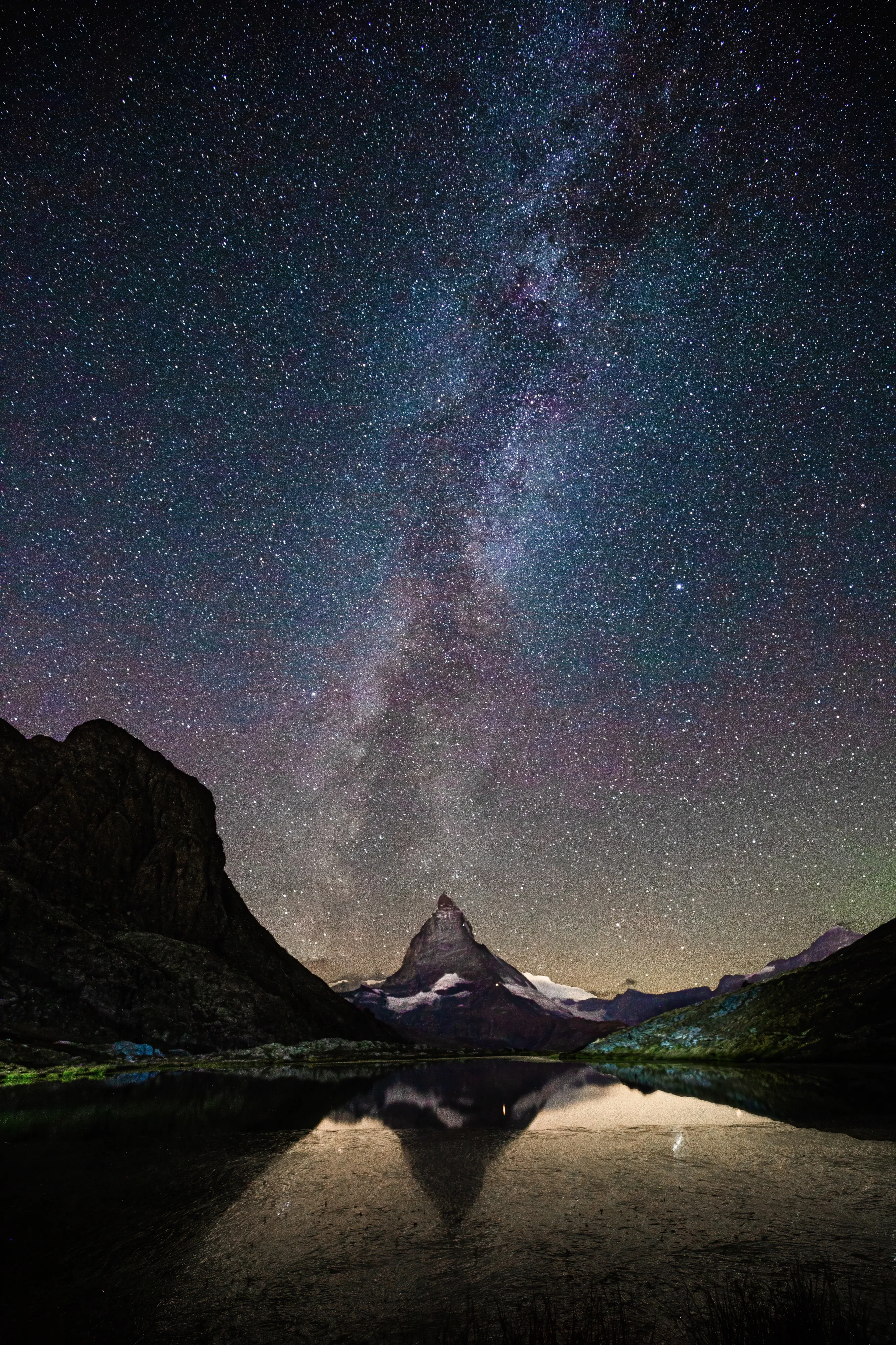
The Alps are one of the best places in central Europe to photograph the night sky. Go high enough and far enough from the cities of the lowlands, and the Milky Way is bright enough to see its structure with the naked eye. Put a famous peak underneath it and you have a picture that is hard to make anywhere else.
Night photography is mostly planning. The time behind the camera is short; the decisions that matter are made days before.
When: season, moon and hour
Season. The bright core of the Milky Way is visible from Switzerland from roughly March to October. In spring it rises in the small hours before dawn. Through summer it is up for most of the short night. By autumn it is already in the south-west as darkness falls and sets soon after.
Moon. This matters more than anything else. Plan for the week around the new moon, or for the hours when the moon is below the horizon. A bright moon washes out the sky.
Darkness. In June and early July it never gets fully dark until close to midnight and the window is short. Late July to September gives longer nights that are still mild enough to be comfortable at altitude.
Weather. You need a clear sky, and in the mountains that often arrives just after a front has passed. Cold, dry air gives the cleanest stars.
Where: what makes a good location
- Altitude and distance from towns. Height puts you above the haze. Valleys with large resorts glow more than you expect.
- A view to the south. The core sits in the southern half of the sky. Your subject needs to be south of where you stand.
- A foreground worth having. A recognisable peak, a mountain lake for reflections, a hut or a chapel.
- Safe access in the dark. You will be walking out at one in the morning. Choose a path you have seen in daylight.
Still water is a gift. On a windless night, a small lake doubles the sky.
Camera settings
| Setting | Starting point |
|---|---|
| Lens | 14 to 24mm, as fast as you have |
| Aperture | f/2.8 or wider |
| Shutter speed | 15 to 25 seconds |
| ISO | 3200 to 6400 |
| Focus | Manual |
| White balance | Around 3800 to 4200 K |
| File format | Raw |
Shutter speed is a balance. Too short and the image is noisy; too long and the stars stretch into short lines as the Earth turns. With a 14mm lens, 20 to 25 seconds is usually safe. At 24mm, keep to about 13 to 15 seconds. Zoom in on a test frame and check.
Focus is where most first attempts fail. Autofocus will not work. Switch to manual, find a bright star in live view, magnify it as far as the camera allows, and turn the focus ring until the star is as small as it can be. Then do not touch the ring again. A strip of tape helps.
In the field
- Use a solid tripod and hang your bag from it if there is wind.
- Trigger with a two-second timer or a remote so that you do not shake the camera.
- Turn off image stabilisation on the tripod.
- Use a red head torch. White light ruins your night vision, and everyone else’s.
- Bring far more clothing than seems reasonable. Standing still at 2,500 metres at two in the morning is cold in August.
- Keep a spare battery warm in a pocket.
Lighting the foreground
A foreground that is pure black can work as a silhouette. If you want detail there are three honest options: shoot during a thin crescent moon, which lights the land gently; take a second, much longer exposure for the ground and blend the two; or use a very dim, warm light from well off to one side. A head torch pointed straight at a hut looks exactly like a head torch pointed at a hut.
Finishing the picture
Night images come out of the camera flat and noisy. The edit matters more here than in any other kind of landscape photography: white balance, contrast in the core, and careful noise reduction. Stacking several identical frames reduces noise a great deal.
Leave it as you found it
Keep to paths, keep the noise down, and keep lights off when you are not using them. Animals are active at night, and so are other photographers.